Early Childhood Development at Home: What Indian Parents Can Do
IAP milestones, talk and play that build a baby’s brain, plus signs that development may need a check.

A baby does not need an app to grow a brain. The baby needs your face, your voice, and time that is not split with a screen. That is the heart of the Indian Academy of Pediatrics (IAP) note on early childhood development.
The parent series is listed on the IAP guidelines for parents page. Screens in these years are covered in screen time guidelines for parents.
Small ages, big firsts
- 4–6 months: the baby listens to voices and begins to copy sounds. This is a lovely time to start reading aloud — not to “teach”, just to sit together. - 6–8 months: stranger wariness appears. A steady caregiver makes the baby brave later. - By about 14 months: a couple of real words, pointing to show you something, peek-a-boo, waving bye, a little copy-cat help with a household task. - 18 months: the child brings you an object as if to say “look”. - 2–3 years: the world still revolves around them. Waiting is hard. - Around 3½–4 years: sharing and a first sense of someone else’s feeling start to show.What you can actually do today
Talk more than you scroll. Look at the baby when you speak. Smile back. Read a picture book from four to six months, even if the book ends up in the mouth. Invite a sibling to pass a spoon. Praise the try, not only the perfect share. Let a child who can climb stairs climb them with you behind. Do not force a toddler to “give it to baby”. Do not give in to every shout either. Both extremes teach the wrong lesson.
IAP is cautious about digital play before three or four. Early screens can get in the way of the mother tongue, of the pincer grasp, and of the looking-and-pointing that language needs.
When to ask a paediatrician
By 14 months, worry productively if there is no pointing, no back-and-forth smile or peek-a-boo, no real words, no wave, and no interest in other children.
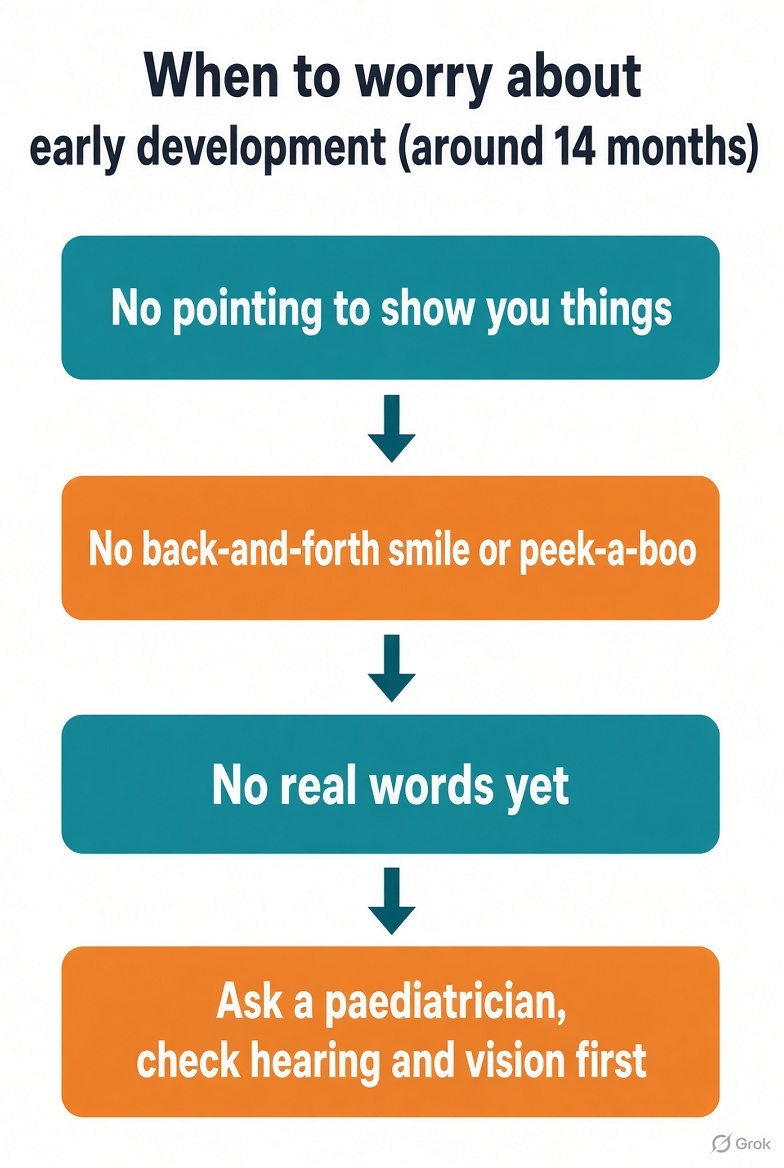
Hearing and vision checks come first. Early help is kinder than waiting for school to “catch it”.