How to Prevent Accidents and Injuries in Children at Home
IAP home-safety steps for falls, burns, drowning, choking and poisoning that Indian families can use today.
Most childhood injuries in India do not happen on a highway. They happen in the kitchen, the bathroom, on the stairs, or with a bottle that looked like a cold drink. The Indian Academy of Pediatrics (IAP) parent guideline on preventing accidents is less about fear and more about a few habits that quietly close those gaps.
You can read the official set on the IAP guidelines for parents page. Safe holding and a firm cot also belong with sleep and physical activity for children.
Walk through the house the way a toddler would
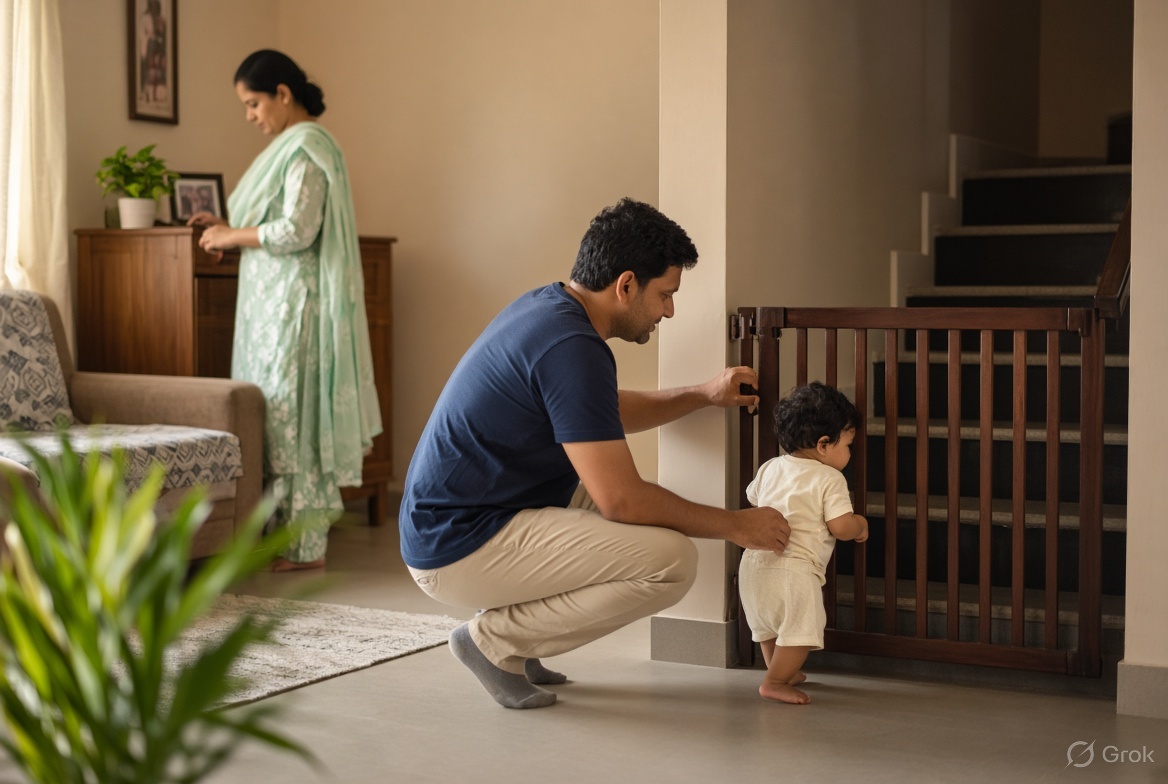
Once a child crawls and climbs, every ledge is a ladder. IAP asks families to look at stairs, balconies, windows and the kitchen platform with that in mind.
- Put a guard at the top and bottom of stairs and at balcony doors. - A parapet should be high and wide enough that a child cannot wriggle over. Avoid horizontal bars that work like a climbing frame. - Lock windows or limit the opening. Nets or grills should not leave a gap wider than about four inches once the child can climb. - Choose steady furniture. Pad sharp corners. Fix a flat TV to the wall so it cannot tip. - Keep tools, knives and any weapon locked. - A cot needs a firm mattress. Space between bars about 5 to 9.5 cm, sides at least 60 cm high, no footholds for climbing out. - Locks on bathrooms and store rooms should sit above four feet, so a small child cannot lock themselves in — or let themselves out too early. - Leave a hall light on at night, or use a sensor light.Kitchen and burns
Keep the stove on a stand, not on the floor. Turn pot handles inward. Do not let a child stand near boiling milk or hot oil. Carry tea slowly around corners. Test microwave-hot food before it reaches a small mouth. Matches, kapoor, incense and diyas belong out of reach. Iron clothes in one decided spot, then put the iron away.
Geysers: do not leave the hot tap open and the cold tap shut. Always check bath water with your own hand before the child gets in. Never leave a baby in the bathroom with another child “in charge”.
Water is enough to drown a toddler
A bucket, a tub, a cooler tank. IAP is blunt: do not store open water in buckets if a small child can reach them. Cover if you must keep water. Bolt the bathroom from the outside when you step out. Skip the bathtub while children are little. Teach swimming after about three to five years. An adult who is actually watching — not scrolling — should be there whenever a child is near water, including a bath. Life jackets on lakes and rivers. Home pools need a fence on all sides with a gate that closes and latches by itself.
Choking and toys
Till three years, toys should be large enough that they cannot disappear down a throat — roughly 3 cm across and 6 cm long. No marbles, coins or loose button batteries. Battery covers should need a screwdriver. No string longer than about 18 cm (7 inches). IAP does not recommend baby walkers.
Poisoning
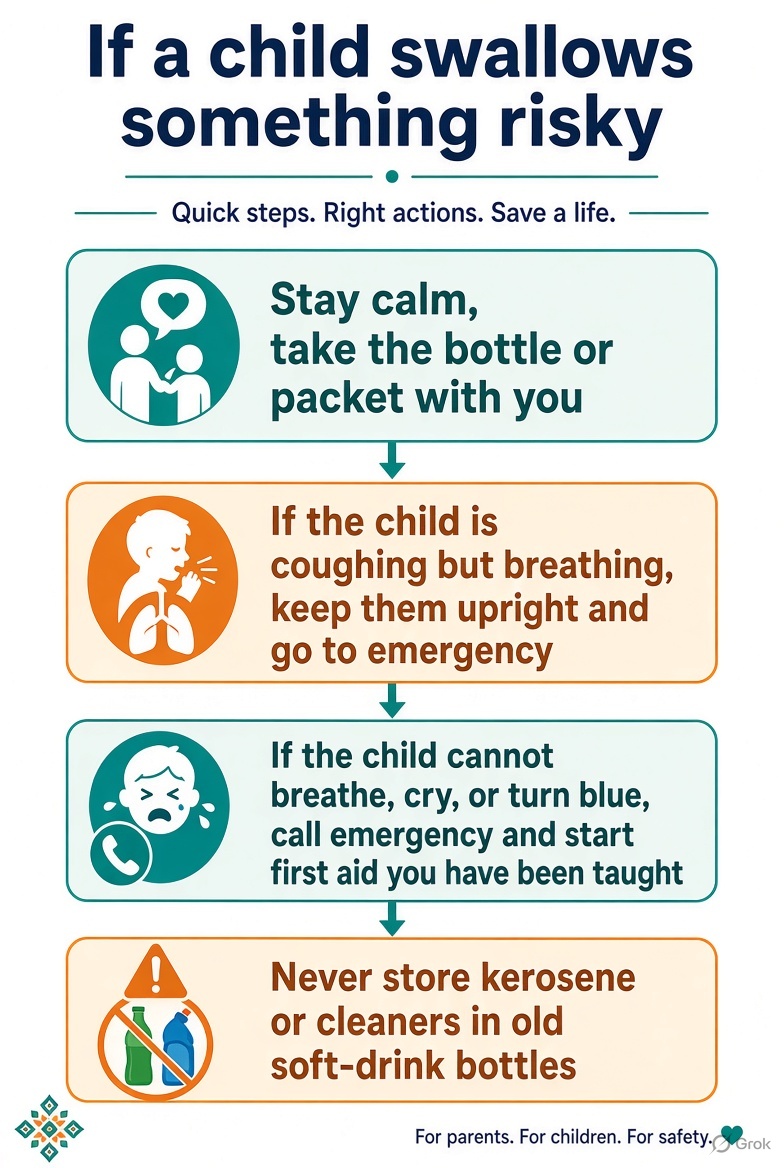
Medicines, phenyl, acids, mosquito liquid, kerosene and rat poison must sit high and locked. Use child-resistant caps when you can. Never pour kerosene or cleaner into an old soft-drink bottle. Never call a tablet “chocolate”. Throw out expired strips. If something is swallowed, take the bottle with you to emergency care.
Electricity and the road
Cover low sockets. Unplug idle gadgets. Keep cords away from water and wet hands. On the road, a child sits in the rear seat with the child lock on, in a seat that fits their size. Never leave a child alone in a parked car.
Holding a baby so the head is safe
Support the head and neck until about three months. Cradle hold, shoulder hold, or a firm waist hold once the baby can straddle — but always a tight, ready grip. Babies wriggle without warning. Age-right slings are fine if the face stays visible and the airway is clear.
When it is an emergency
Learn basic first aid and CPR before you need them. Know which nearby hospital runs a child emergency through the night. Go now if the child cannot breathe, turns blue, has a burn that is large or on the face or hand, had a fall from a height, or swallowed a battery, kerosene or a cleaner.